Why Chris Cocks taking direct control of Wizards of the Coast ends badly for everyone if this is the direction they stick to and what a version that works would look like.
On July 21, Chris Cocks got on the earnings call and told analysts that Magic: The Gathering had done $545.3 million in a single quarter, which is the first time in the game's 30-plus year history it has cleared $500 million. Six days after that, a filing with the SEC disclosed that John Hight, the president of the division that produced that number, was on his way out. On September 1 he was gone, nobody was named to replace him (not even on an interim basis), and the Wizards leadership team now reports directly to Cocks while Hasbro conducts what it is describing as a thorough search.
The headline numbers make this look like a non-event, and honestly, if you only read the earnings release you would probably come away thinking Hasbro is in the best shape it has been in for years. This is not a case study about a struggling business. Wizards is the healthiest thing Hasbro owns by a wide margin and Cocks has a legitimate claim to having built a lot of it. My argument is narrower than that. The current structure, where the CEO is personally running the one segment that makes all the money, sitting on top of a product strategy that is already showing strain at the store counter and in the secondary market, is the kind of arrangement that looks fine right up until it doesn't, and when it stops looking fine there is nobody left in the org chart whose job is to absorb the damage. It lands on players and stores first, then on Wizards employees, and eventually on shareholders, in roughly that order.
Full disclosure on where I sit, because it colors the read. I started playing Magic around Fourth Edition, stopped somewhere in the early 2000s when life got in the way, and kept the collection anyway, boxed up and moved from apartment to apartment for over two decades. I dusted it off and picked the game back up recently, which puts me squarely in the demographic Wizards is counting on right now, the lapsed player with some disposable income who walks back into a store, sees a wall of product, and has to figure out how much of it is actually for him. So when I talk about set fatigue and price increases below, I'm not just reading forum threads, I'm the guy standing at the counter doing the math.
1. Where things actually stand
Hight came over from Blizzard in August 2024 to replace Cynthia Williams, who had lasted roughly two years in the seat, and Hight lasted roughly two years as well. Both of them reported to Cocks, who ran Wizards himself from 2016 to 2022 before becoming Hasbro's CEO. Hasbro has said publicly that Hight's departure and the $56 million write-down on cancelled video games announced the same week are in no way connected, and I'll take them at their word on that, but it doesn't really change the structural picture. Here is that picture in numbers, pulled from the Q1 and Q2 2026 10-Qs and the Q2 earnings release.
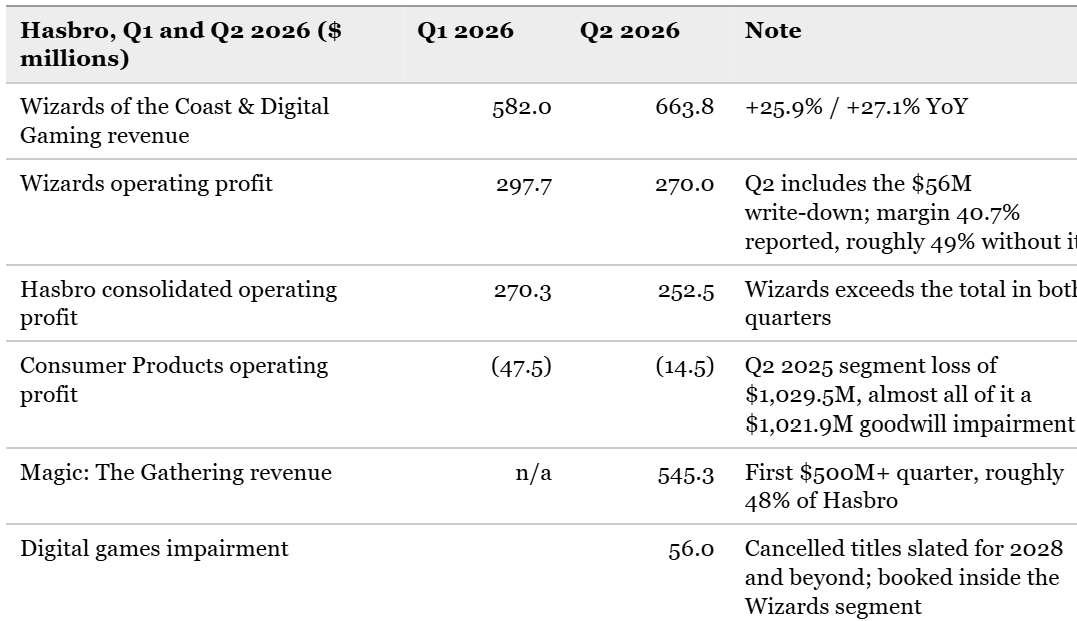
The row that matters most is the third one. In both quarters this year, Wizards of the Coast generated more operating profit than Hasbro did as a whole company, which means everything else Hasbro owns, netted together, either loses money or roughly breaks even. Magic by itself is approaching half of consolidated revenue. On the strength of that quarter Hasbro raised full-year guidance to 5 to 7 percent growth and 25 to 26 percent adjusted operating margin, and on the call management said it now expects a minimum of $200 million in share repurchases this year, double the earlier target, leaning into the $1 billion authorization. Every one of those commitments is a bet that Wizards keeps carrying the building, and I don't think anyone at Hasbro would argue with that characterization.
One thing to get right before going further, because it's the place a careful reader can check me against the filing in thirty seconds. Wizards' reported margin fell to 40.7 percent from 46.3 percent, and the CFO said on the call that the 560 basis point drop was due to the impairment. The $56 million write-down sits inside the $270 million of segment profit, and it's about 8.5 points of margin on $663.8 million of revenue, so strip it out and the underlying margin was roughly 49 percent, up from a year ago, not down. That matters for the argument I'm about to make, and I'll come back to it. It also means the royalty pressure from licensed sets is not something you can prove from the Q2 print. It shows up elsewhere: in the deck's list of product development, marketing, and other investments, in Consumer Products citing higher royalty expense, and most of all in guidance that says Wizards margins stay in the high 30s to low 40s through 2027, after the write-down year is over, while the calendar is still loaded with licensed sets and the 2027 game launches start amortizing.
A few more facts you'll need for the rest of this. On the Q2 call, Gina Goetter guided Wizards to low double-digit growth for the full year but, in the Q&A, said Q4 would be down low single digits against the record Q4 of 2025, with roughly $40 million sliding into Q1 2027 because next year's first set lands in early February instead of mid-January. On the same call Cocks said the company made a deliberate decision entering the year to increase initial print and distribution runs for Magic releases. The 2026 Magic calendar carries seven premier sets (ten products once you count the supplemental stuff), four of them licensed Universes Beyond sets, and Wizards' own head designer, Mark Rosewater, has said on his blog that 2026 is an outlier and future years will settle at three original and three licensed. Collector Booster MSRP moved to $26.99 from $24.99 and Commander precons to $49.99 from $44.99, and Wizards said in writing that those are the new standard prices. On the digital side, Sigil, the 3D virtual tabletop for D&D, lost 90 percent of its roughly 30-person team within a month of launching in 2025 and its servers go dark on October 31 of this year. The Magic: Arena team filed with the NLRB on April 27, Wizards declined to recognize the union voluntarily, and the team voted 79 to 16 to join the CWA in a count finalized June 23. Cocks told investors that 2026 is the peak year for digital investment, that digital spend comes down at least 25 percent by 2028, and that development is shifting to Montreal to reduce what he called man-month costs.
2. The steelman, because it deserves one
If I'm sitting on Hasbro's board this is one of the easier calls I make all year, and I think it's worth laying out why before I start pulling it apart. Cocks ran Wizards for six years and Magic grew substantially on his watch. He hired both of the presidents who came after him, both of them lasted about two years, and a reasonable person could look at that and decide the problem was the hires and not the seat. A CEO temporarily overseeing a division after its head leaves is pretty standard governance and not some kind of power grab. The numbers are at all-time highs (Hasbro's own brand sheet says Magic has grown in seven of the last eight years at a 16 percent compound rate over the past decade), the underlying margin just expanded, the 2027 slate is already promised at a more disciplined three-and-three cadence, the stock jumped roughly 12 percent on the Q2 print, and Cocks has been telling investors that Magic belongs in the same conversation as Pokémon and Minecraft as a mega franchise. From where the board sits, the guy who built the engine is stepping back in to make sure nobody stalls it during a search, and that is a coherent story with competent people behind it.
That being said, the reason I think this ends badly is not that the story is wrong today. It's that the structure removes the only person whose job was to tell Cocks when the story stops being true, and the strategy underneath it has a few things in it that somebody in that seat should already be pushing back on.
3. Why it ends badly if they stick with it
1. There is no longer anyone between the CEO and the cash machine. A division president at Wizards has one structural purpose that no other role at Hasbro can really fill, which is protecting the long-term health of two games against the short-term needs of a public company that has nothing else generating profit. I don't mean that as a knock on Cocks, it's just what the seat is for. Hight's job, whether or not he was any good at it, was to be the person who could say not this year to a fourth licensed set, or to a price increase, or to a subscription pivot for D&D, and to say it to someone who had to listen. That seat is empty now, the person who would have heard the objection is the person making the call, and the person making the call has already told Wall Street the number he needs to hit. On top of that he is simultaneously managing a Consumer Products segment that took a billion-dollar goodwill impairment last year, a March cyber incident that cost somewhere around $11 million, tariff pressure, an entertainment segment that shrank 20 percent, and a Harry Potter toy launch. Something in that list gets the leftover attention, and in my experience with Hasbro the thing that gets the leftover attention is usually the community-facing stuff. The timeline makes it worse. Retained searches for a seat at this level typically run four to eight months from engagement to start date at the big five firms, and three to six months when everything goes right, so a search that started in late July realistically lands somewhere between December and next spring. That means the CEO-as-division-head structure almost certainly runs through the holiday quarter, the Reality Fracture and Star Trek launches, the Sigil shutdown, and the Q4 print that Hasbro already guided down, with nobody in the seat.
2. The product strategy is churn and burn, and they've trained their audience accordingly. Ten Magic products in 2026, with seven premier sets and four of them licensed, is a calendar that maximizes this year's print, and I'd point out that the 16 percent compound growth Hasbro likes to cite was earned mostly in years when Magic shipped four premier sets, not seven, so cadence was never what drove the growth. Layer the bigger print runs Cocks described on top of that and you have more product, more often, at higher prices. The pricing side has its own problem. BLS puts the consumer price index for toys, games, and hobbies down about 3.3 percent a year on average since 1997 (that's the official basket, not a Magic-specific deflator, and electronics inside it do some of the deflating, but the direction is not in dispute), and into that Wizards pushed Collector Boosters up 8 percent and precons up 11 percent and called it the new standard. The secondary market has already started voting on it. Per MTGStocks' tracking, Final Fantasy Collector Booster boxes peaked around $1,500 in 2025, while Spider-Man Collector boxes fell below $300 and Avatar below $400 after both had traded near $1,000. The polite industry read on that is a collectibles market getting more discerning, but I think the more accurate read is a collectibles market that got burned and is adjusting its buying behavior for the next one. Wizards' own communications lead said last fall that the fatigue is mostly an online thing, and Rosewater said this spring that 2026 is an outlier, and those two statements can't both be the company's position at the same time. Now, about the royalties. I said above that you can't see the licensed-IP cost in the Q2 margin, because the write-down swamps it, and I meant it. What you can see is that Hasbro expects a lower margin in 2027 than the roughly 49 percent Wizards just ran underneath the impairment, while shipping a calendar that is still half licensed. Wizards is buying growth with someone else's IP and paying rent on it, and the rent is in the forward guidance, not the print. Hasbro also just posted three senior openings for a dedicated D&D Universes Beyond team, so the same model is being exported to the other game. Brian Kibler's point about the shockland cycle getting split across a Standard rotation because Lorwyn was pushed to make room for a licensed set is the one I keep coming back to, because it means the licensing calendar is now dictating game design, and once that happens the game slowly turns into a distribution channel for other people's brands.
3. Digital is a four-year execution gap, and the guy now running it wrote the original plan. Sigil was announced in 2022 during the era of Cocks-driven digital ambition, launched in February 2025 with almost no marketing, lost 90 percent of its team within a month, and shuts down at the end of October. The Respawn-veteran D&D game was cancelled less than a year after it was announced, Atomic Arcade was shuttered, and Hasbro announced roughly 1,900 job cuts in 2023 alone (about 800 in January and another 1,100 in December, against a year-end 2022 headcount of 6,490, so close to 30 percent of the company) with the December round scheduled to run through 2025. Hasbro just took the $56 million impairment, told investors digital spend is coming down 25 percent, and is moving development to Montreal to cut labor cost, in the same quarter its Arena developers won their union election 79 to 16 after citing layoffs, return-to-office mandates, and AI as their reasons. Wizards accepted the result and now has to bargain a first contract, and I'd tell them to do that fast and quietly, because a drawn-out first-contract fight in the same year you're moving development to a cheaper city is a headline you don't need, and GDC's 2026 survey found 62 percent of game professionals interested in joining a union and 28 percent laid off in the prior two years, so this is not a problem that gets smaller by waiting. The part that tends to get lost in the segment reporting is that a meaningful share of the Digital and Licensed Gaming line, $41.4 million in Q1 and $44.2 million in Q2 per the 10-Qs, is Monopoly Go!, which is a Scopely product paying Hasbro a royalty. If you strip that out, Wizards of the Coast and Digital Gaming is mostly Magic tabletop plus a licensing check. Cocks didn't inherit this digital strategy from Hight, he inherited it from himself, and so far every corrective action has been subtraction.
4. Community trust is a one-way door. The OGL mess in early 2023 happened with Cocks as CEO, and the numbers on it are worth remembering: an open letter with more than 26,000 signatures, what insiders described to Gizmodo as five digits' worth of D&D Beyond cancellation tickets in the system within days (on a platform with 12 million registered users), and Paizo pulling Kobold Press, Chaosium, Green Ronin, and others onto a competing open license. Wizards reversed course specifically because of what sources called a provable impact on the bottom line, which tells you the community can move the needle when it wants to. There is precedent for the long tail too. When Fourth Edition D&D shipped in 2008 without a real open license, Paizo built Pathfinder on the old rules and, per ICv2's quarterly rankings, outsold D&D for stretches of 2011 through 2013. That was the last time Wizards walked through this particular door, and it cost them the top spot in their own category. Then there's AI. Cocks described himself as an AI bull in 2025 and said AI in D&D was inevitable, then in March 2026 said Magic and D&D will never use generative AI, then in June 2026 Hasbro launched an AI studio that licenses Hasbro characters out to third parties. The audience's position on this is not ambiguous. Quantic Foundry's survey of gamers in late 2025 found 85 percent negative on generative AI in games, 62 percent very negative, and under 8 percent positive, which the firm said was the most lopsided result it had recorded for any feature in years of survey work, worse even than blockchain games. On the builder side, GDC's 2026 survey has 52 percent of industry professionals saying generative AI is hurting the industry, up from 18 percent two years earlier, with only 7 percent calling it a positive. D&D, meanwhile, has been drifting toward D&D Beyond as the primary delivery mechanism, with physical books increasingly positioned as collector items. Each of those decisions is defensible on its own, and taken together they teach the audience not to trust whatever the next announcement is. This is the Community > Content pillar in the most literal sense I can put it: content is what Wizards sells, and community is the only reason it gets to sell it again next quarter. Changing the price of a booster, you can walk back. Changing the terms of the community's relationship to the game, you can't, and Wizards has done it several times since 2023 with the same person at the top.
5. The succession signal filters the candidate pool toward people who won't push back. Two presidents, two years each, both reporting to Cocks, both gone, and no interim named, which is unusual for a division this size. If you are a serious external candidate, the offer on the table is to report to a CEO who did your job for six years, who just did it again for however long the search takes, and who has a stated, public view on how the product should be run. The people who take that offer are operators who will execute Cocks' plan rather than challenge it, which is fine if the plan is right, and the product, digital, and community points above are my case that it has some drift in it.
4. What they've planned versus what a player-first version actually looks like
I want to push back on a framing I hear a lot in the community, which is that Hasbro has to choose between making money and taking care of the people who play. I don't think that's true, and I don't think the history of this category supports it. The most durable businesses in games and collectibles are the ones that figured out that the player is the asset and the product is just how you monetize the relationship. Lego nearly went under in 2003 chasing every adjacent category it could find, refocused on the brick and its adult fans, and in 2025 did DKK 83.5 billion (about $13 billion, roughly three times Hasbro) at a 26.4 percent operating margin. Games Workshop is the comparison that matters because it is a hobby business selling to the same kind of customer. In its fiscal year ended May 2026 it did £659.7 million in revenue and £275 million in operating profit, a 41.7 percent operating margin, with no licensed IP in the core product at all, a customer base that complains about prices constantly and keeps buying anyway because the company visibly protects the hobby, and an annual report that says out loud it measures success on growing sales while holding margin, not on squeezing more margin out of the same players. And here's the thing: Wizards' underlying margin is already higher than that. It ran about 49 percent under the impairment. Hasbro does not need to squeeze anybody to have one of the best margin businesses in the category. It's choosing to. Even inside Wizards, the biggest format in Magic today, Commander, was invented by players, run by a volunteer committee for years, and only later adopted by the company, which is about as clean an example of Community > Content producing profit as you're going to find. So the question isn't whether you can be profit-oriented and take care of your customers, it's whether the current plan is set up to do both, and I'd argue it isn't. Here's the side-by-side as I see it:
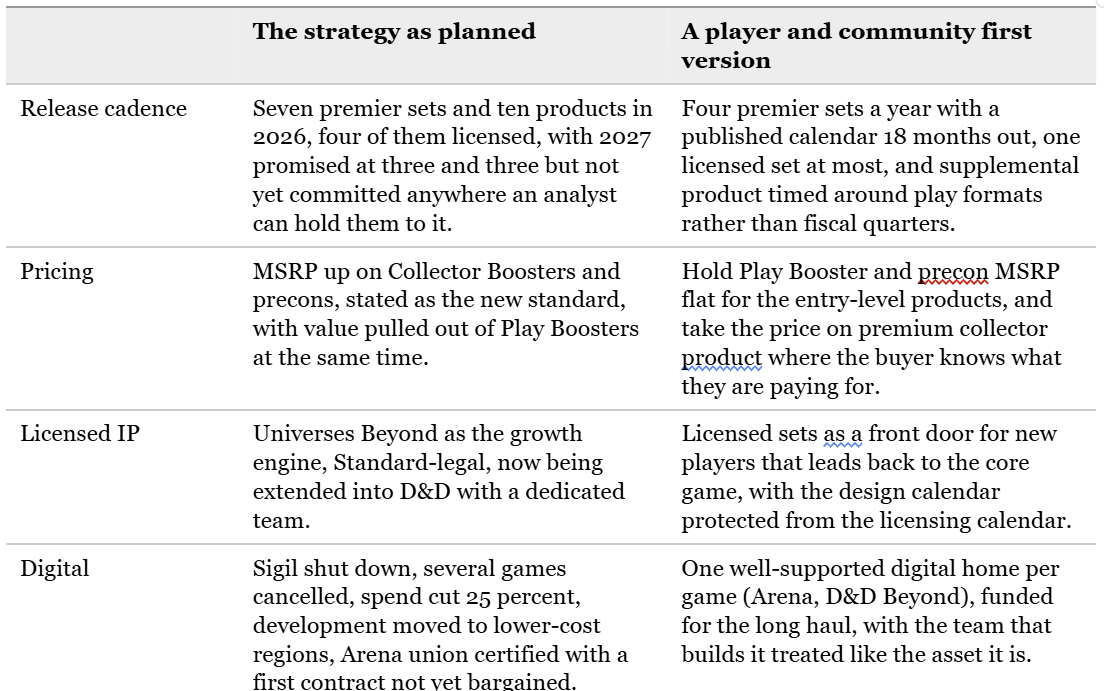
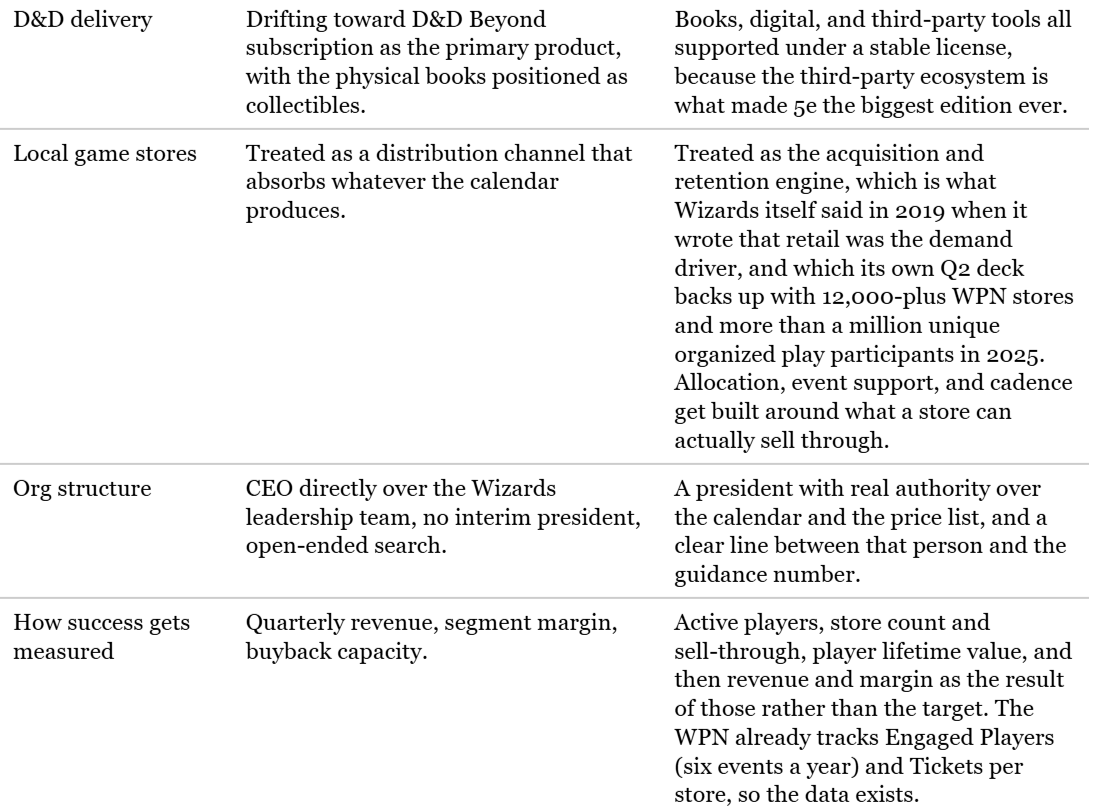
The economics of the right-hand column are not soft. Hasbro's own investor fact sheet puts Magic at $1.72 billion of revenue in 2025 against what it describes as 50 million lifetime players, with 80 percent of the active base classified as casual, and the Q2 deck adds that more than a million unique players showed up for organized play in 2025, that the average player is 35 with more than five years in the game, and that the WPN now runs through 12,000-plus stores. I don't have an active buyer count, and this is the only way I know to back into an average: if 10 to 15 million of those 50 million bought something in a given year, that's $115 to $170 per player, and since the casual 80 percent by definition pulls that average down, the engaged 20 percent (the million-plus who play in stores is a decent proxy) are almost certainly spending several hundred dollars a year each on sealed product, singles, event fees, and Arena. A returning player like me who gets a good first year back and stays for a decade is worth somewhere in the $3,000 to $5,000 range over that stretch, and that revenue costs Wizards almost nothing to retain compared to what it costs to acquire a new Marvel or Final Fantasy buyer who may only ever purchase one box. Hasbro's own numbers make the point for me: its five biggest Magic releases ever (Avatar, Final Fantasy, Modern Horizons 3, Lord of the Rings, Modern Horizons 2) have each passed $200 million lifetime, and three of the five are licensed, so the front door clearly works. The question is what happens after people walk through it. The store that sells that player their first precon back is also the store that runs their Friday night draft, teaches their kids to play, and moves the singles from the last three sets, and none of that shows up in a quarterly print but all of it shows up in the next decade of Magic revenue. Licensed sets are a fantastic front door, and I'm not arguing against them, I'm arguing against letting the front door become the house. When the calendar is built around this year's print, the acquisition spike goes up and the retention curve quietly goes down, and by the time the retention curve shows up in the numbers you've already spent two years training the audience to wait for the next crossover instead of engaging with the game.
I checked all of this against BLS's Consumer Expenditure Survey, since the elasticity argument only holds if the target cohort's spending actually behaves the way I'm describing. Hasbro's deck puts the average player at 35, which sits right on the line between BLS's 25 to 34 and 35 to 44 age groups, so I looked at both. For households headed by someone 25 to 34, the toys, hobbies, and playground equipment line ran $123 in 2019, $193 in 2020, $306 in 2021, $184 in 2022, $177 in 2023, and $307 in 2024, so that cohort roughly doubled its hobby spending last year, back to the pandemic peak, which fits Magic's run. It did that against a nearly flat backdrop: total spending per household was $78,535 in 2024 versus $77,158 in 2023, under 2 percent growth, the only statistically significant increase was housing (owned dwellings up 7.0 percent, rent up 5.4 percent), and entertainment's share of the wallet slipped to 4.6 percent. That's a discretionary line getting stretched, not a cohort with room to absorb price increases. The elasticity signal is in the history, because that same series spiked 58 percent from 2020 to 2021 and then gave back 40 percent in 2022, which is exactly the boom-and-revert pattern this whole document is worried about. The 35 to 44 cohort, which is where Hasbro's average player actually lives and where the people who kept a collection through two decades live, had already dropped from $307 in 2023 to $245 in 2024 while the younger group surged. Two caveats I'd want any client to hear: 2024 is the most recent survey year, so everything about 2025 and 2026 pricing and set fatigue is ahead of the data, and this is a small, noisy line that swings hard year to year. Still, an engaged Magic player spending several hundred dollars a year on one game is putting more into it than the average household in their cohort puts into the entire toys and hobbies category, which is the strongest version of the point: Magic is over-indexed on a small, volatile budget line, so it feels price and volume mistakes early.
Now, the player-first column isn't a charity. Four sets instead of seven with flat entry pricing probably costs Hasbro some revenue in the first year, maybe meaningfully so, and it would be dishonest to pretend otherwise. What it buys is a slower, longer, more predictable revenue curve with a lower royalty load (so higher margin, which the underlying 49 percent says is very much available), a healthier secondary market that makes sealed product easier to sell, a store channel that isn't drowning in inventory, and a community that gives the company the benefit of the doubt on the next digital bet instead of assuming it will be cancelled. If I'm modeling the two paths for a client, the planned strategy wins the next four quarters and the player-first strategy wins the next four years, and the whole point of having a Wizards president who reports to the CEO rather than being the CEO is that somebody in the building is paid to care about the second timeline.
5. Playing it forward on a napkin
Take the Q2 run rate, roughly $528 million in tabletop revenue and $270 million in segment operating profit. Assume the secondary market correction and set fatigue produce a 10 percent pullback in tabletop, which is not an aggressive assumption given what already happened to Spider-Man and Avatar collector product, and given that Cocks just told investors they printed more of everything this year. That's about $53 million of revenue in a quarter, and at the segment's roughly 41 percent reported margin somewhere around $22 million of operating profit, call it $85 to $90 million annualized. Against a consolidated operating profit figure that is already smaller than Wizards' own, that is a direct hit to the only number the raised guidance and the doubled buyback depend on, and there is no other segment to cushion it. Then layer on the 2027 plan, which has fewer licensed sets (the ones setting the records) at the same time Hasbro is telling investors Wizards margins stay in the high 30s to low 40s despite heavy amortization and marketing for the Exodus and D&D: Warlock launches. The comparison gets harder and the cost base gets heavier in the same year. I'd flag all of this as illustrative rather than a forecast, but the shape of it isn't really in dispute, because Hasbro has concentrated its entire earnings story in one division and then removed the layer of management that existed to protect that division's long-term health.
If you want the historical rhyme, it's sitting right there in the record set's name. Marvel Comics rode a speculator-driven collectibles boom through the early 1990s, flooded the market with variant covers and crossover events, watched the secondary market collapse, and filed for Chapter 11 in December 1996. Funko did a smaller version of the same thing in 2022 and 2023, overproduced into a softening collector market, and took a $30.3 million write-down in Q1 2023 for inventory it then physically destroyed, a plan it told the SEC was completed by the third quarter of that year. Hasbro itself did it in 2023, Cocks' first full year as CEO, with a billion-dollar-plus impairment on eOne and the first of the big layoff waves. The pattern is more or less the same every time, a collectible product line posts a record, the company builds its capital allocation around the record continuing, and the people closest to the customer get overruled by the people closest to the guidance.
6. What I'd tell them if we hopped on a call
1. Name an interim president inside 30 days, from within, and put it in writing that the leadership team's reporting line to the CEO is temporary and has a date on it. The point isn't the person, it's restoring the seat whose job is to say no, and I'd give whoever it is explicit authority over two things and only two things for now: the release calendar and the price list. Retained search benchmarks say four to eight months for a seat like this, which puts a permanent hire somewhere between December and spring. If the search runs into 2027 with Cocks still in direct control, the market and the community will both read that as the permanent structure regardless of what the press release says, and every candidate the search firm calls will read it the same way, which is how you end up with the yes-man problem from section 3 baked in before anyone is hired. This one costs nothing and it's the only recommendation on this list that makes the other ones possible.
2. Put the three-and-three 2027 cadence and a 12-month hold on Play Booster and precon MSRP into the next earnings deck as a shareholder commitment rather than a designer's blog answer. Discipline that lives in a Tumblr post doesn't move the needle with anyone, discipline that an analyst can ask about on the call does. The numbers say they can afford it: Magic compounded at 16 percent a year over the past decade mostly on four premier sets, the underlying margin is around 49 percent, the category's price index has fallen roughly 3.3 percent a year for 29 years, and the 25 to 34 cohort's hobby spending has already shown it can drop 40 percent in a single year once a spike runs out.
3. Give D&D its own reporting line, or at minimum a stated post-Sigil digital plan, before the new Universes Beyond team ships a licensed D&D product. Right now D&D is being asked to absorb the Magic playbook without having earned the Magic economics, and it has a much smaller margin for error with its audience than Magic does. D&D Beyond's 12 million registered users, five digits of cancellation tickets in a week in 2023, and Pathfinder outselling D&D for stretches of 2011 to 2013 the last time Wizards mishandled the license are the three numbers I'd keep on the wall.
4. Pick one position on AI and hold it for 24 months, because with 85 percent of your customers negative and 62 percent very negative, the only position that costs you nothing with the people paying is a clear one.
5. Start reporting active players and store sell-through alongside revenue, even if only internally at first. You can't run a community-first strategy on a dashboard that only shows quarterly revenue and margin, because those are the outputs, and the whole argument of this document is that the inputs are what's drifting. Wizards already collects this: the WPN scores every store on Tickets and Engaged Players, the Q2 deck already cites a million-plus organized play participants and 12,000-plus stores, Hasbro reports 13 million registered Arena players, and Games Workshop writes in its annual report that its short-term success measure is growing sales while holding core operating margin, which is an input-first framing Hasbro could borrow tomorrow.
And Lastly…
I'd rather be wrong about this, and I'll be the first to say so if Hasbro names a strong president by the end of the year and the 2027 slate lands the way Rosewater described it. The record quarter isn't the story. The story is who is in the room when the next set gets greenlit, or the next price increase, or the next digital write-down that needs explaining, and right now that room has one person in it, and he's the same person who has to explain the guidance to Wall Street. If you're a store owner, a returning player like me, an employee, or a shareholder, you have my permission to stop treating $545 million as the reason to relax and start treating it as the reason to pay attention.
Sources
Figures are drawn from company filings and results releases wherever they exist, with trade press used for the community and product detail. Where a number is my own estimate I've said so in the text.
• Hasbro Form 10-Q for the quarters ended March 29, 2026 and June 28, 2026 (segment revenue and operating profit tables; Q2 2025 Consumer Products goodwill impairment of $1,021.9M per the Q2 2026 release).
• Hasbro Q2 2026 earnings release, slides, and call transcript, July 21, 2026: Magic $545.3M, $56M digital impairment booked in the Wizards segment (CFO: margin down 560 bps due to the impairment), Monopoly Go! $44.2M, raised guidance, $200M minimum repurchase and $1B authorization per the call, Wizards guided to low double-digit full-year growth with Q4 down low single digits per Goetter in the Q&A, increased initial print runs, average player age 35 with 5-plus years tenure, 12,000-plus WPN stores, 1M-plus unique organized play participants in 2025.
• Hasbro investor site, Magic: The Gathering brand fact sheet: $1.72B FY2025 Magic revenue, 50M lifetime players, 13M registered Arena players, five releases over $200M lifetime. (The fact sheet gives an average player age of about 30; the Q2 2026 deck says 35. I used the newer figure.)
• Hasbro Form 8-K filings dated January 26, 2023 (approximately 1,000 positions, later reported as roughly 800 executed) and December 11, 2023 (approximately 1,100 positions); year-end 2022 headcount of 6,490 per Hasbro.
• SEC filing dated July 27, 2026 disclosing Hight's Transitional Advisory Services Agreement; Polygon report of September 1, 2026 on the interim reporting structure.
• Draftsim, October 2025: Collector Booster and Commander precon MSRP increases; MagicCon Atlanta comments on fatigue. GameSpot, May 2026: Rosewater on 2026 as an outlier.
• MTGStocks, January 2026 macro trends piece: Final Fantasy, Spider-Man, and Avatar Collector Booster box price ranges.
• D&D Beyond Sigil Sunset FAQ (October 2025) and Gizmodo reporting on the March 2025 layoffs. Arena union: NLRB filing April 27, 2026; election June 2; count finalized June 23, 79 to 16 of 102 eligible, per EN World, Wargamer, and Star City Games; Wizards' statement accepting the result. Gizmodo (March 2026) and EN World (June 2026) on Cocks' AI statements and the Hasbro AI studio.
• Games Workshop Group PLC results for the 52 weeks ended May 31, 2026 (July 28, 2026): revenue £659.7M, operating profit £275.0M.
• The LEGO Group 2025 annual results (March 10, 2026): revenue DKK 83.5B, operating profit DKK 22.0B, 26.4% operating margin. 2003 loss figure per contemporaneous reporting on the Lego turnaround.
• Funko Form 10-K for FY2023: $30.3M inventory write-down and physical destruction plan completed in Q3 2023.
• Marvel Entertainment Group Chapter 11 filing, December 1996.
• BLS Consumer Expenditure Survey, 2024 (released December 19, 2025): average annual expenditures $78,535, housing +3.3 percent, entertainment share 4.6 percent; FRED series CXUTOYSLB0403M (toys, hobbies, and playground equipment, age 25 to 34) and CXUTOYSLB0404M (age 35 to 44).
• BLS Consumer Price Index, toys, games, hobbies, and playground equipment: average annual change of roughly minus 3.3 percent, 1997 to 2026. This is the official category index, which includes electronics and video games; it is not a trading card deflator.
• Wizards of the Coast, Introducing the New Wizards Play Network (2019): retail as the demand driver, in-store play quadrupled in ten years, Tickets and Engaged Players metrics. Store count updated to 12,000-plus per the Q2 2026 deck.
• Gizmodo (January 2023) and Axios (January 23, 2023) on the OGL episode: five digits of D&D Beyond cancellation tickets, 26,000-plus open letter signatures, 12 million registered D&D Beyond users; ICv2 quarterly hobby game rankings, 2011 to 2013, for Pathfinder versus D&D.
• Quantic Foundry gamer survey, December 2025: 85 percent negative on generative AI in games, 62 percent very negative, 7.6 percent positive. GDC 2026 State of the Game Industry survey (2,300-plus respondents): 52 percent negative on generative AI, 7 percent positive, 62 percent interested in joining a union, 28 percent laid off in prior two years.
• Executive search timeline benchmarks: retained searches at Spencer Stuart, Russell Reynolds, and Heidrick & Struggles typically four to eight months from engagement to start date; industry benchmark of three to six months for well-run searches.
• Player revenue and lifetime value figures in section 4 are my own estimates built from Hasbro's published Magic revenue and player counts, not a published Wizards number.